
1. The “Final Library” was never going to be singular
When I first started thinking about what I called a “Final Library,” I pictured a single, civilization-scale repository of synthetic writing, synthetic hypotheses, and machine-generated explanations. The basic premise was simple: once AI systems can generate and refine ideas at industrial scale, they will produce a body of scientific and intellectual literature and theory so large that no human can read, curate, or even meaningfully browse it without machine assistance.
But the more I sit with it, the clearer it becomes that this will not arrive as one monolithic library. It will arrive as many.
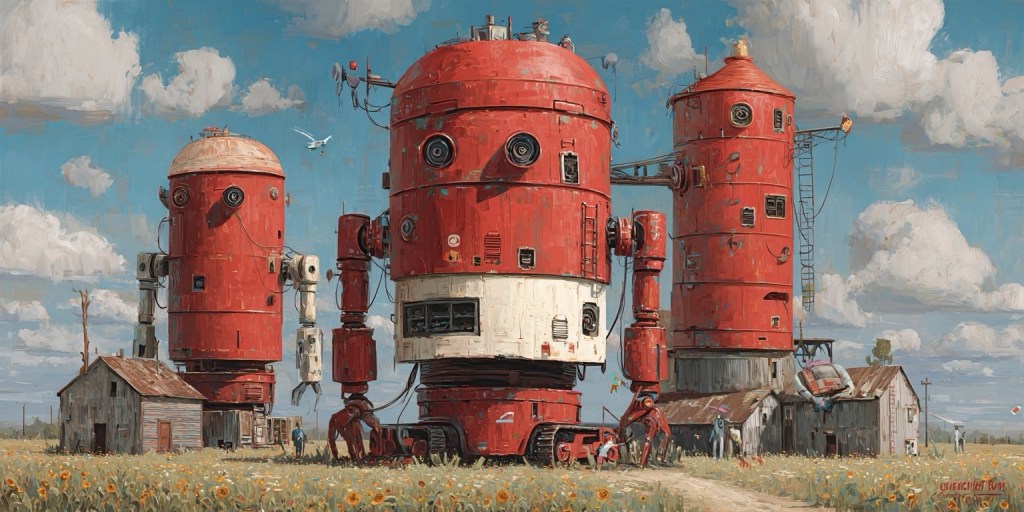
The near future probably looks like a world of plural canons. Different companies, and later different institutions, will each build their own enormous synthetic corpus. Each corpus will include overlapping public material, but also model-generated content, internal evaluations, proprietary data, and restricted tool outputs. The result is not only epistemic abundance, but epistemic fragmentation.
The shift matters because it changes the social contract of knowledge. We are leaving a world where “the literature” is, at least in principle, a shared reference point. We are moving toward a world where the most valuable and operationally decisive knowledge may live inside gated systems.
2. Why the canons will diverge
It is tempting to think that if all these systems are trained on the internet, they should converge. In the early years, there was likely heavy overlap across major training mixes simply because the public web was the dominant substrate available to everyone. But the incentive structure pushes hard toward divergence.
There are two reasons.
First, web-scale data is increasingly a commodity with constraints. Access, licensing, and filtering regimes differ, and those differences matter. Second, synthetic data is not neutral. Once you start generating training material, the generator shapes the distribution. A system’s “children” look like it.
Over time, each major lab will build a distinctive pipeline, and the pipeline will become the canon. Different pipelines will mean different preferred ontologies, different decomposition styles, different safety constraints, different “default explanations,” and different blind spots.
If you want a short explanation for why this is inevitable, it is this: you cannot industrialize cognition without leaving fingerprints. Those fingerprints will appear in the synthetic corpus.
3. What goes into a canon
A useful way to picture these corpora is to ask what kinds of objects they will contain. At minimum, a mature canon will include:
synthetic writing: explanations, summaries, tutorials, arguments, critiques synthetic hypotheses: conjectures, mechanisms, proposed causal graphs, testable predictions synthetic derivations: proofs, proof sketches, formalizations, theorem-prover artifacts synthetic research programs: structured plans for inquiry, prioritized experiments, dependency graphs of ideas synthetic negative space: refutations, dead ends, failed attempts, and discarded hypotheses, if the system is well-designed
That last category is easy to underestimate. If the canon keeps only “successful” outputs, it becomes a propaganda machine for its own plausibility. If it keeps failure and uncertainty, it becomes more like a living research mind.
This is where we should be honest. These systems will carry errors. They will embed uncertainty. They will sometimes be wrong in ways that are locally coherent. That is not a footnote. It is the default condition of any epistemic engine that operates at scale.
4. The first era: synthetic knowledge without experimental closure
In the near term, much of what these canons produce will be what I would call “paper knowledge.” It will be reported knowledge, reorganized. It will be plausible hypotheses. It will be novel conceptual syntheses. It will be arguments that feel correct. It will be insights that do not require new measurement to articulate.
This is the stage we are already entering. A system can read across literatures faster than any person, recombine concepts, and produce a coherent framework that looks like an original contribution. In some domains, it can also formalize claims and verify them in proof assistants or check them with computation.
This kind of output changes how intellectual work feels. It changes the personal experience of trying to be original. It creates a subtle pressure: if the machine can generate ten plausible hypotheses in the time it takes you to write one, the meaning of “contribution” shifts.
But there is also a deeper change. Once canons are producing hypotheses at scale, the bottleneck becomes verification. Not “writing” in the rhetorical sense, but closure.
5. The second era: verification throughput becomes the power source
The decisive transition will occur when synthetic corpora are tightly coupled to mechanisms of verification. This is not a single invention. It is an ecosystem.
Verification can happen in several ways:
Formal domains Mathematics, logic, and parts of computer science can be pushed into proof assistants and formal checkers. In these spaces, synthetic claims can be converted into verified objects. Computational closure In many engineering domains, claims can be evaluated by simulation, unit tests, model checking, or large-scale computation. This does not create truth in the philosophical sense, but it creates strong constraints. Empirical loops The largest leap comes when AI is coupled to laboratories, instrumentation, automated experimentation, and robust replication. At that point, a canon begins to contain new measurements and new facts, not merely new prose.
As soon as verification throughput becomes high, the canon stops being an archive of plausible text. It becomes an epistemic machine that generates and prunes beliefs with increasing competence.
This is where fragmentation becomes dangerous and interesting. If one canon has better verification loops, it becomes epistemically stronger. If its results are then restricted, access becomes power.
6. Continual learning without omniscience
A key confusion in public discussion is the question of continual learning. People imagine a system that either “can” or “cannot” learn after training, as if that is a binary property. In practice, learning will occur through two mechanisms, both of which matter.
First, there is corpus growth without weight updates. A system can add new synthetic hypotheses, proofs, and research plans to an external repository and then retrieve from that repository at inference time. The system is not “learning” in the strict weight-update sense, but it is improving. Its effective cognitive reach expands.
Second, there are weight updates and fine-tuning loops. Some systems will periodically train on selected slices of the repository, plus real-world feedback and new external data. This is riskier, because bad synthetic content can poison the model if the filters are weak, but it is also powerful.
So the realistic picture is not omniscience. It is error-correcting accumulation. Over time, the canon becomes a memory substrate, and the system becomes a navigator and curator of its own growing intellectual history.
The adult way to state this is simple: these systems will not become perfect. They will become increasingly good at locating uncertainty, routing it into tests, and remembering what has already been tried.
7. The social consequences of plural canons
Plural canons change the epistemic ground beneath us. They introduce a new set of civilizational dynamics.
Knowledge becomes partially privatized Not only in the sense of paywalls, but in the sense that key claims may rely on internal data, internal toolchains, or internal evaluation protocols. Consensus becomes harder When different canons produce different “best answers,” disagreements can become harder to resolve because the underlying corpora are not identical and cannot be fully compared. Institutional worldviews harden Each canon will have a preferred style of explanation. Over time, users trained by one canon may begin to think in its categories. This is subtle, but real. The verification gap widens Inside a company, claims might be supported by internal traces, provenance, and experiments. Outside the company, the public may see only polished summaries. That is a recipe for dependency.
This is where I think we need to be candid. The plural-canon world can intensify what I previously called Epistemic Infantilization. Not because people become stupid, but because the structure of access encourages deference.
8. A workable response: cross-canon adulthood
I do not think the right response is panic, and it is not denial. It is a set of habits and norms that preserve adult epistemic agency even when knowledge production is no longer human-led.
In a world of plural canons, the mature stance looks like this:
Triangulation When stakes matter, consult multiple systems and look for convergence and divergence. Treat divergence as a signal, not an inconvenience. Provenance demands Ask what is observed, what is inferred, what is simulated, and what is merely plausible. Demand audit trails where possible. Preference for portable claims Prioritize claims that can be checked against public literature, public datasets, or public formal proofs. Ownership of ends Do not outsource values. Do not outsource the selection of what matters. The machine can propose, but humans should remain the authors of aims.
If I had to summarize the goal in one sentence, it would be this: we should treat the canons as engines, not parents.
9. Closing: the new landscape
The world I am describing is not a single Final Library that everyone consults. It is a competitive landscape of synthetic corpora, each with its own strengths, biases, access rules, and verification loops. That landscape will generate more synthetic writing, synthetic hypotheses, and synthetic “knowledge objects” than humans can ever curate unaided. Some of it will be siloed. Some of it will be blocked from competitors and from ordinary users. Some of it will be strategically withheld.
This does not mean truth disappears. It means truth becomes mediated by institutions that operate cognitive engines at scale. If we want the future to feel adult, the task is to build norms, tools, and personal habits that preserve epistemic sovereignty, even as we accept that the frontier has moved into machines and into the canons they maintain.
If you want to make this concrete in later writing, the next step is to define what counts as a “good canon” in ethical and epistemic terms. Not just powerful, but transparent, auditable, corrigible, and interoperable. In a plural-canon world, interoperability may be the difference between a flourishing cognitive commons and a fragmented knowledge oligarchy.
 Iterated Insights
Leave a comment