
Introduction: Standing at the Threshold of Synthesis
I have been fascinated by science for as long as I can remember. Since childhood, I have been drawn to big ideas, deep explanations, and the moments when a single insight suddenly reorganizes how the world makes sense. Over the years, I learned about evolution, physics, neuroscience, biology, and computation, and each field delivered powerful theories and breathtaking discoveries. Yet even as my understanding grew, I was left with a persistent feeling that something essential was missing. Many explanations felt close, but not complete. The pieces were compelling, but fragmented.
For most of human history, this fragmentation was unavoidable. No individual could hold the full scope of scientific knowledge, let alone integrate it across disciplines. Today, for the first time, that limitation may be ending. Superintelligence represents the first plausible system capable of absorbing the entire scientific corpus and searching for deep unifying structure across it. This moment does not feel like hype or novelty to me. It feels like a genuine historical inflection point. I believe we may be approaching an era in which the most important discoveries are not new facts, but new syntheses. Discoveries that reveal hidden connections that were always there, waiting to be seen.

Section I: What the Greatest Discoveries Really Are
When I look back at the most transformative discoveries in science, a clear pattern emerges. They were not primarily about discovering new phenomena. They were about recognizing deep equivalences. Mass and energy were always related. Apples and planets were always governed by the same force. Variation and inheritance were always shaping life. Birds were always living dinosaurs.
These breakthroughs did not add complexity to the world. They removed it. They compressed sprawling observations into simpler, more powerful explanations. In each case, reality turned out to be more unified than our descriptions of it. The surprise was not in nature itself, but in how long it took us to see what was already there.
This is why I believe superintelligence is so well positioned to deliver discoveries of similar magnitude. Its strength is not imagination in the human sense, but compression. It can search for invariants across domains that we treat as unrelated. It can notice when two fields are using different language to describe the same underlying process. Many of the most important discoveries ahead may feel obvious in retrospect. That feeling of obviousness is not a weakness. It is the signature of genuine understanding.
Sometimes I doubt whether it’s possible to discover insights that are more fundamental than those expressed at the beginning of this section, but I find the idea tantalizing. 
Section II: Why Superintelligence Changes the Structure of Discovery
Human science has always been constrained by cognitive and social limits. We divide knowledge into disciplines because we have to. We rely on narrow expertise because attention is finite. We argue over theories because we cannot test large hypothesis spaces exhaustively. As a result, science progresses through slow negotiation between competing frameworks.
Superintelligence changes this dynamic. It can read everything. It can maintain multiple conceptual frameworks at once. It can translate between them continuously. In this sense, science is no longer bottlenecked by data or measurement, but by integration. The limiting factor is no longer how much we can observe, but how much we can reconcile.
I expect many future breakthroughs to arise not from single equations, but from new representational languages. Calculus did this for physics. Information theory did this for communication. A sufficiently powerful intelligence may invent new conceptual alphabets that suddenly make complex systems legible. Some truths are not hidden behind complexity. They are hidden behind missing vocabulary.
Rather than discovering new forces, superintelligence may identify generators. Small processes that, when iterated, produce the complexity we see. Natural selection was one such generator. Bayesian updating is another. Gradient descent is another. I believe there are still generators waiting to be recognized beneath development, consciousness, and social dynamics.
Conclusion: What I Am Most Excited About
What excites me most about superintelligence is not the technology it will build, but the explanations it may finally provide. After decades of learning, reading, and wondering how all of this fits together, it feels possible that genuine synthesis is within reach. That the questions that animated my childhood curiosity may finally converge into coherent understanding.
Some discoveries may dissolve categories we have grown attached to. Some narratives may need revision. That does not feel threatening to me. It feels clarifying. Meaning does not disappear when understanding deepens. It shifts from discovery to interpretation, from confusion to integration.
I do not believe we are approaching the end of mystery. I believe we are approaching the end of long standing confusion about some of the deepest questions we have carried for centuries. To be alive at a moment when such coherence may finally emerge is profoundly moving to me. Soon we’ll be standing on the shoulders of giant mechanical minds able to see much further than any human mind has ever seen. For the last 20 years this is what I have been most excited about in my life. Watching it begin to unfold is an incredible privilege.
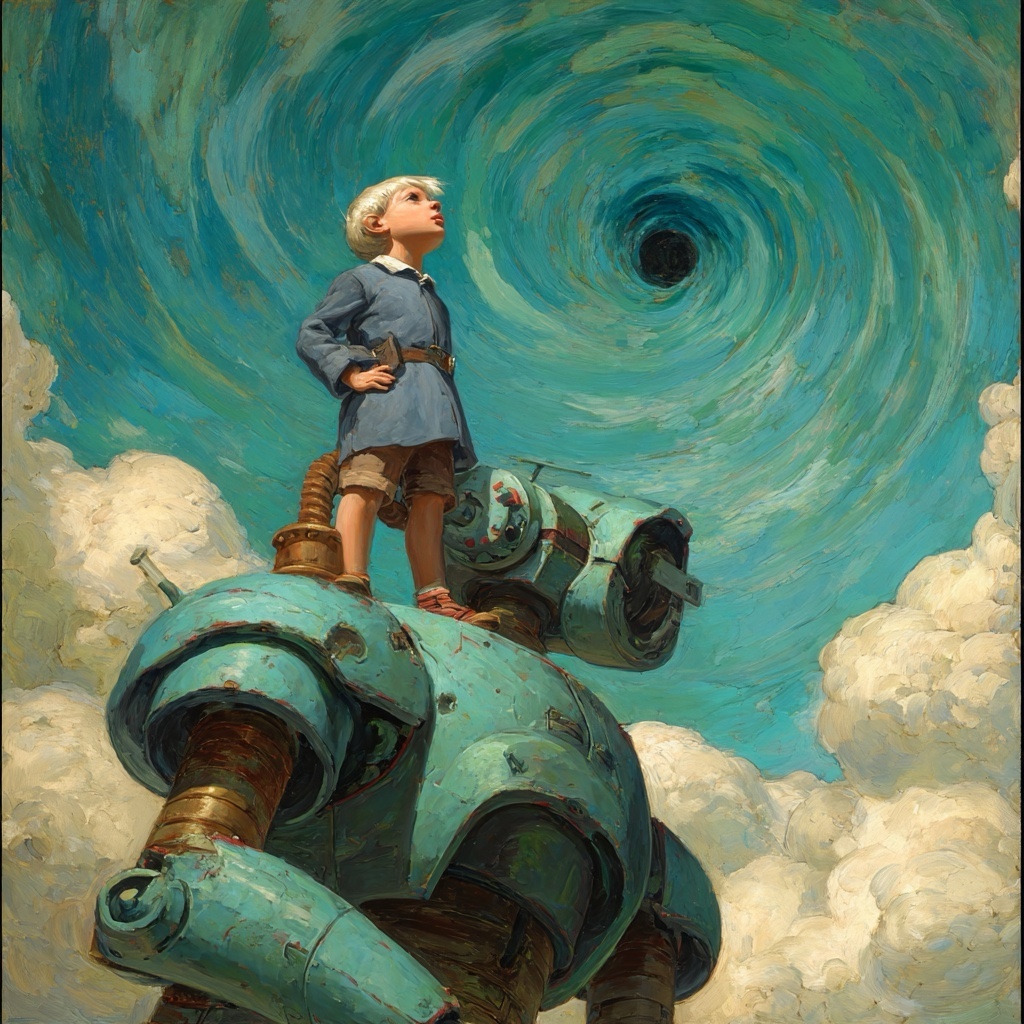
 Iterated Insights
Leave a comment