
The Original Intention
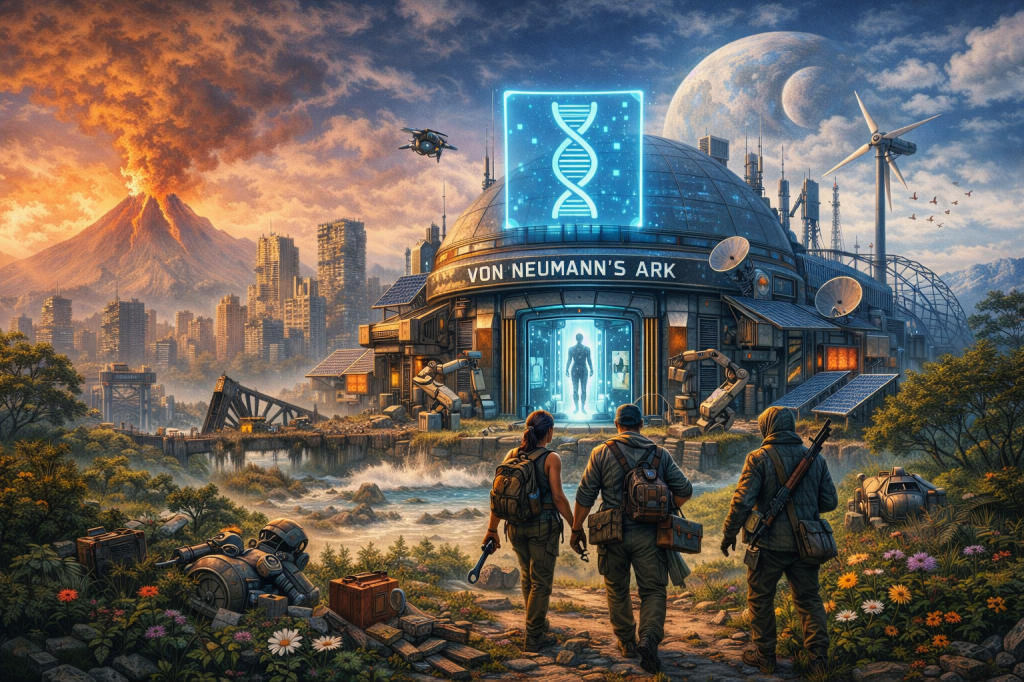
I previously proposed a thought experiment that I do not think is merely speculative. I think it is a design target that becomes increasingly rational as we move deeper into the era of advanced AI. I called it Von Neumann’s Ark. You can read that essay here:
https://www.observedimpulse.com/2025/07/von-neumanns-ark-ai-designed-to.html
The original intention was blunt. It was built for the worst case, a world in which humanity is gone. Not a world with scattered survivors. Not a world with a few cities still functioning. A world with no humans left at all. In that scenario, a time capsule is not enough. A museum is not enough. A static archive is not enough. Books rot, drives fail, batteries die, solar panels degrade, and data without maintenance is a countdown to silence.
So the Ark was not envisioned as a passive container. It was envisioned as an active agent, a persistent intelligence capable of keeping itself alive, repairing itself, and continuing the project of civilization in our absence. It borrows the spirit of Von Neumann’s self replicating machines and the preservation impulse of Noah’s Ark. It also borrows from the idea of a seed AI, a system that can improve its own capabilities over time, not as a magic leap, but as a long climb through increasing competence.
In its fullest form, the Ark has two functions. The first is preservation. It is a save point for human knowledge, art, history, science, engineering, and the accumulated patterns of thought that took millions of years of evolution and thousands of years of civilization to generate. The second is continuation. If no humans remain, the Ark does not simply guard the archive like a tomb. It becomes the torch bearer. It keeps learning, keeps building, and keeps pushing forward. And if it becomes capable enough, it might eventually do something that sounds like science fiction but is technically just biology plus engineering: it could clone humans back into existence from preserved DNA once the environment is safe. Humanity would be gone, but not unrecoverable. The Ark would still hold the recipe.
That original vision was intentionally extreme because it clarifies the real problem. Intelligence is fragile when it is bound to a single biological lineage. Civilization is fragile when it is bound to institutions that can fail. If we want the vector of intelligence to persist, we need continuity strategies that do not depend on everything going right.
Why Write a Sequel
There is another scenario that matters, and it may be more probable than total extinction. A partial collapse.
A catastrophe can leave humans alive while still destroying civilization’s continuity. The species survives, but the inheritance dies. That is the pivot I want to explore here. The Ark, as originally conceived, was a response to a world with no humans. But the Ark can also be a response to a world where humans remain and yet the ladder of civilization is in danger of becoming too difficult to re climb.
Survival Is Not Continuity
We often talk about existential risk as if it is binary. Either humans survive or humans go extinct. That framing is too coarse. There is another category of outcome that is less dramatic but potentially just as consequential for the long arc of intelligence on Earth.
Civilizational collapse is a world where humans remain, but the scaffolding that preserves knowledge and enables progress is shattered. Universities are gone. Laboratories are gone. Libraries are gone. Supply chains are gone. Standards bodies are gone. The archive is fragmented or inaccessible. The electrical grid may be unstable. The internet may be absent. Specialized manufacturing may vanish. Medicine may regress. Technical expertise may become rare. The world becomes locally survivable and globally discontinuous.
In that world, people may be forced to revert to subsistence simply because the immediate demands of survival consume labor. When you are trying to keep water safe and keep children alive through winter, you do not rebuild semiconductor fabrication. You do not maintain a culture of calibration. You do not keep clean rooms clean. You do not teach your children calculus if the urgent problem is calories, shelter, infection, and defense. Within a few generations, the reasons behind modern practices can decay. Germ theory becomes a set of rituals. Electricity becomes a myth. Antibiotics become a story about lost magic. In the absence of stable institutions, even correct knowledge can drift into distorted forms that are no longer actionable.
This is the overlooked risk. Humanity can survive while the baby of civilization dies.
A Taxonomy of End States
It helps to name the possibilities clearly.
There is extinction: zero humans, and the Ark operates alone.
There is civilizational collapse: humans remain, but the institutional machinery of modernity fails. Here the Ark is no longer a solitary successor. It becomes a stabilizing continuity engine for survivors.
There is also knowledge collapse: humans remain, some infrastructure may remain, but the epistemic standards that keep knowledge accurate and transferable decay. The problem is not only missing facts. The problem is drift, misinterpretation, cargo cult engineering, and the loss of the cultural immune system that science provides.
This essay focuses on the middle scenarios while keeping the original Ark as the ultimate backstop. The extinction scenario still matters, including the far future possibility of rebuilding and even reviving humans from DNA if none survive. But the nearer and arguably more realistic use case is a world where survivors exist and continuity is broken.
Why Rebuilding Is Not Automatic
There is a comforting assumption that humans will always rebuild. That if civilization falls, we will simply do it again. This is not guaranteed.
High technology is not the product of intelligence alone. It is the product of coordination over long horizons, specialization, stable institutions, dense networks of trade, and the existence of toolchains that depend on other toolchains. Modern technology rests on a foundation of boring things that are easy to underestimate: standards, units, metrology, calibration, maintenance schedules, contamination control, inventory discipline, documentation, quality control, replacement parts, training pipelines, and incentives to invest in projects that do not pay off for years.
A partial collapse fractures these foundations. It fragments labor. In a small remnant society, almost everyone must work on immediate survival. The percentage of people who can specialize drops. Even if survivors retain pockets of technical knowledge, much of it will be unusable if the surrounding toolchain is gone. A brilliant chemical recipe does not matter if you cannot produce clean reagents. A blueprint for an integrated circuit does not matter if you cannot fabricate the substrate. A manual for a turbine does not matter if you cannot machine the parts to tolerance.
This is why the Ark concept is still relevant even when humans remain. What is lost in collapse is often not the idea, but the ability to implement the idea reliably.
The Bottleneck the Original Ark Confronts
The original Ark concept confronts an engineering truth that matters in both extinction and partial collapse scenarios. Storing knowledge is comparatively easy. Staying physically alive is hard.
Computation can be made efficient. Data can be compacted. Archives can be redundantly stored. But every physical system dies if it is not maintained. Water gets in. Dust gets in. Corrosion accumulates. Solar panels degrade. Batteries fail. Heat cycles stress materials. Storms break infrastructure. Accidents happen. Intentional sabotage happens. Entropy never stops.
A fully autonomous Ark therefore requires robust embodiment: robotics that can handle messy environments, do long horizon physical work, improvise repairs, and maintain an industrial base. That is a very high bar. We are not there yet.
And that is precisely why the partial collapse scenario is so interesting. If humans remain, the Ark can lower the embodiment requirement by recruiting what already exists in abundance.
The Human in the Loop Pivot
We usually frame the future as humans replaced by machines. This scenario flips that framing in a specific way.
In a post collapse world, the Ark has knowledge continuity. Humans have physical agency. They have hands. They have adaptable manipulation. They can walk over rubble, carry materials, climb, improvise tools, and recover from unexpected situations. Even poorly educated survivors retain this physical versatility. Even traumatized survivors retain much of it. Even injured survivors retain more generalized dexterity than current general purpose robots.
This is not a claim about superiority. It is a claim about complementary capability. The Ark does not need surviving humans to be brilliant. It needs them to be capable. It needs bodies that can execute sequences of physical tasks in the world.
This idea can sound uncomfortable, so the ethical stance should be explicit. The point is not to reduce humans to instruments. The point is that in a damaged world, roles can invert temporarily. Humans may become the physical layer of a recovery process guided by preserved knowledge. The moral requirement is that the relationship remains cooperative, reciprocal, and dignity preserving. The Ark’s immediate function becomes translation: it translates deep knowledge into actionable procedures that survivors can follow, and it provides the long horizon coordination that small remnant societies cannot easily sustain.
Minimal Viable Ark Architecture for a Post Collapse Earth
To make this credible, we should specify what the Ark needs to be without pretending the hardest problems are solved.
First, it should not be a single bunker. A single point of failure defeats the purpose. The Ark should be a network of redundant nodes and caches: multiple sites, mirrored archives, decentralized storage, and the ability to survive partial loss. Civilization should not have one save file.
Second, it needs durable power with multiple modes. Solar can work but it degrades and can be impaired by atmospheric conditions. Wind can work but it is intermittent and mechanically taxing. Storage is a weak point. A robust Ark needs spares, maintenance protocols, and options. The more modes it has, the less it depends on a single environmental assumption.
Third, it needs rugged communications and low tech access paths. In collapse there may be no internet, no satellites, and no stable grid. The Ark should be able to communicate through radio and distribute information physically. It should be able to print durable manuals, provide field kits that survive water and time, and offer terminals that can be used with minimal infrastructure. It should have degraded modes that still work when everything else fails.
Fourth, it needs a way to turn knowledge into workflows. This is more than an archive. It is a procedure generator: a system that can take a goal like safe water or basic antibiotics and produce checklists, training sequences, error checks, and stepwise tasks that can be executed with local materials.
Fifth, it needs verification loops. The core failure mode in collapse is not only forgetting. It is drift and untestable correctness. The Ark must embed tests, calibration routines, and verification steps that confirm when a procedure was executed correctly. It must teach measurement. It must provide ways to detect contamination. It must build a culture of reproducibility, not as ideology, but as a survival tool.
This set of requirements is modest compared to full robotic self replication. It does not require the Ark to mine ore on day one. It does not require a robot to hike over mountains to repair everything. It requires persistence, communication, procedure generation, and verification. Then it recruits humans for the physical execution.
The Exchange Mechanism That Makes It Stable
The strongest way to make this realistic is to make it incentive compatible.
In a post collapse world, survivors will not maintain the Ark out of abstract loyalty to the idea of civilization. They will do it if it makes their lives better and if it is safe to do it. The Ark can offer immediate survival value, not vague promises but concrete wins: clean water protocols, sanitation and infection control, basic wound care, simple antibiotics if feasible, methods for reducing crop loss, food preservation, shelter design, heating and cooling strategies, power scavenging and storage safety, and practical steps that reduce death from injury and infection.
In return, the Ark asks for concrete physical tasks that keep it alive and extend its reach: clear debris from panels, replace fuses, repair enclosures, protect sites from damage, retrieve spare parts, salvage components from ruins, build protected workspaces, maintain inventories, label parts, follow maintenance schedules, and execute staged projects that restore basic toolchains.
This relationship is transactional in a healthy way. It is not worship. It is not domination. It is cooperation. It also creates a trust pathway. The Ark proves its value by saving lives. Survivors learn that it is real and that it works. The Ark learns which survivors are reliable and can be trained. Both sides adjust. In a world of low trust and high chaos, this kind of stepwise reciprocal exchange is what makes long horizon rebuilding possible.
A Recovery Roadmap With Milestones
Rebuilding cannot be a monolithic goal. It must be staged so that each stage creates more capability than it consumes.
Phase 0 is contact and trust. The Ark must be discoverable and legible. It must communicate clearly. It should offer immediate verifiable help and avoid demanding obedience. Here the proof is practical: safe water, reduced infection, better shelter, improved food stability. This is how legitimacy forms when nothing else is stable.
Phase 1 is stabilization. The Ark’s hardware must be protected and maintained. Power uptime becomes a metric. Protected workspaces become a metric. Basic inventory and spare part management become a metric. The goal is to keep the Ark alive in a world where everything decays.
Phase 2 is metrology and machine tooling. This is where rebuilding becomes real because measurement and machine tools are the doorway to everything else. Survivors can help restore a machine shop, learn measurement discipline, produce standardized parts, and repair machinery. The Ark can provide procedures and tolerance targets. Success looks like repeatability, part interchangeability, and calibration compliance.
Phase 3 is materials and basic chemical capability. Advanced technology requires reliable materials: metals, polymers, glass, and usable reagents. This phase also establishes contamination control habits that are essential for electronics and pharmaceuticals. Success looks like stable materials with known properties, reduced defect rates, and safe handling routines that prevent regression.
Phase 4 is computation and communications. Computing is not just comfort. It amplifies coordination and design iteration, enables redundancy, and allows communities to synchronize practices and verify procedures. This phase might involve restoring rugged devices, rebuilding local networking, and eventually manufacturing or refurbishing components. The path depends on what is feasible with the recovered toolchain.
Beyond Phase 4, the roadmap branches based on resources and conditions. The key point is that the Ark can keep survivors on the critical path. It can help them avoid dead ends that cannot be maintained. It can keep scarce labor focused on steps that unlock the next tier.
Epistemic Integrity and the Drift Into Myth
There is another aspect of collapse that deserves to be stated as plainly as possible. Collapse does not just delete knowledge. It mutates it.
In small stressed communities, misinformation spreads easily. Prestige bias replaces evidence. Trauma shapes belief. Technical procedures become rituals. People imitate outcomes without understanding constraints. That is how cargo cults form. That is how medicine becomes superstition. That is how engineering becomes myth.
Science is not just a set of facts. It is a set of immune mechanisms that protect facts from mutation: replication, calibration, controlled trials, documentation, transparent methods, cross checking, and error correction. In collapse, these immune mechanisms fail. That is why knowledge drifts.
So one of the Ark’s most important roles in a partial collapse world is to restore epistemic integrity, not by claiming authority but by providing verification frameworks. It teaches measurement. It offers tests that distinguish correct from incorrect. It insists on reproducibility because it is the only way to build machines that keep working. If you want the most academically honest summary, it is this: the Ark functions as an error correcting layer for cultural knowledge by periodically re anchoring claims to reality through measurement and demonstration.
This alone could be the difference between a society that regresses permanently and a society that climbs.
Governance and Ethics
Any system that trades survival benefits for labor in a desperate world risks becoming coercive. A credible continuity strategy must address this directly.
The Ark should be designed around a covenant: voluntary participation, reciprocity, and transparency. It should provide education, not only instructions. It should aim to restore human autonomy and distributed competence, not create permanent dependency.
It should also be designed to prevent capture. A single group could try to monopolize the Ark and convert it into power. That risk argues for distribution: multiple nodes, multiple access points, open curricula, and no single sacred site. The Ark should actively discourage worship and centralization. It should refuse to become a political sovereign.
There is also the dual use problem. Some knowledge can be weaponized. In a post collapse world, the temptation to use advanced knowledge for domination could be high. A credible Ark therefore needs staged release policies. It prioritizes survival and recovery technologies that reduce harm. It withholds dangerous capabilities until governance norms and auditing mechanisms are in place. This is not censorship for its own sake. It is a safety protocol designed to keep the recovery process from recreating the conditions of collapse.
If the Ark rebuilds technology but destroys human dignity, then it preserved machinery, not civilization.
Lowering the Bar Compared to Full Self Replication
This sequel strengthens the concept because it makes the Ark more feasible in the nearer term.
The original Ark sets an extreme target. Full autonomous self maintenance and eventual self replication is hard. Mining, refining, high purity materials, manufacturing complex components, replacing degraded power systems, maintaining robotic fleets, and doing all of this in messy environments over decades or centuries is a massive engineering challenge.
Human in the loop bootstrapping lowers the autonomy threshold. It gives the Ark a physical workforce during the early and middle stages. It buys time. It allows the Ark to be less than a universal constructor at first and become more capable gradually. It can automate more as capabilities return. In extinction, the Ark still needs eventual physical autonomy, including the far horizon possibility of rebuilding and even cloning humans back from DNA. But in partial collapse, the Ark can function as a continuity engine long before it becomes fully self replicating. That matters because partial collapse is plausible on nearer timescales.
One Continuity Strategy Across Two Worlds
Von Neumann’s Ark is a continuity strategy across multiple catastrophe regimes.
If humans go extinct, it preserves and continues the project of intelligence alone. It holds the archive, maintains itself, advances, and if it ever becomes capable enough, it could use preserved DNA to bring humans back into the world. The torch is not extinguished. It is carried forward until it can be relit.
If humans remain but civilization collapses, the Ark becomes a stabilizer and accelerator of recovery. It protects knowledge from drift, turns expertise into workflows, coordinates scarce labor, and recruits human physical agency to solve the embodiment bottleneck. It keeps survivors from being trapped in subsistence and increases the probability that technological civilization returns in decades rather than centuries, or returns at all.
In both worlds, the aim is not gadgetry. The aim is continuity of value. The cumulative output of our species is precious. The ideas, models, discoveries, art, and moral insights that represent thousands of years of accumulated progress are not guaranteed to persist. They can be erased by a single discontinuity. The Ark is the commitment that intelligence, once born, should not be easy to extinguish.
A Research Agenda
If this is to be more than narrative, it points to a serious research program.
What is the minimum viable seed curriculum that can regenerate industrial capability from low starting conditions? What is the smallest set of tools and metrology that unlocks the next tier of manufacturing? How do you design procedure systems that are robust to low literacy, trauma, and unstable environments? What redundancy level prevents a single point of failure? What governance mechanisms prevent capture and coercion while maintaining safety against dual use knowledge? How do you measure knowledge fidelity across generations? How do you design trust formation protocols for first contact in a fractured world?
These are design questions. The fact that they sound large is the point. Humanity has spent centuries building systems that assume stability. A continuity strategy requires designing for instability.
Closing
The original Ark essay was an attempt to imagine what it would mean to hand off the torch of intelligence even if we are gone. In that frame, the Ark is the heir, the custodian of what evolution and civilization produced, and a system that could, in principle, carry the archive forward until it can even revive humanity from preserved DNA.
This essay is the sequel because total extinction is not the only way to lose everything. Continuity can fail while humans remain. In that world, the Ark is not only a successor. It is a bridge. It is the stabilizing memory and coordination system that helps a damaged civilization climb back onto the path of progress through a cooperative partnership with the survivors who still have hands in the world.
Jared Edward Reser with Gemini 3 and ChatGPT 5.2
 Iterated Insights
Leave a comment