
The Final Library and The Last Years of Human-Original Thought
We are approaching a point where artificial intelligence will not only outthink humans in every measurable way but also outproduce every insight that humans are capable of generating. This transition will not unfold through magic or sudden emergence. It will happen through the steady expansion of the machine’s ability to search, combine, evaluate, and elaborate ideas far beyond the bandwidth of biological cognition. The question is not whether AI will replace human thought but what the process of replacement will look like. The outlines are becoming visible.
The first phase is already here. AI is beginning to write everything that humans write. It can explain, argue, synthesize, speculate, and compose with breadth and fluency that exceeds the human baseline. It can expand a fragment of an idea into a complete conceptual structure. It can take a hypothesis, test its coherence, generate alternate framings, and then produce the entire downstream intellectual ecosystem that the idea implies. This is the first step: the machine becomes the mechanism of expression. The second step is more consequential: the machine becomes the mechanism of invention.
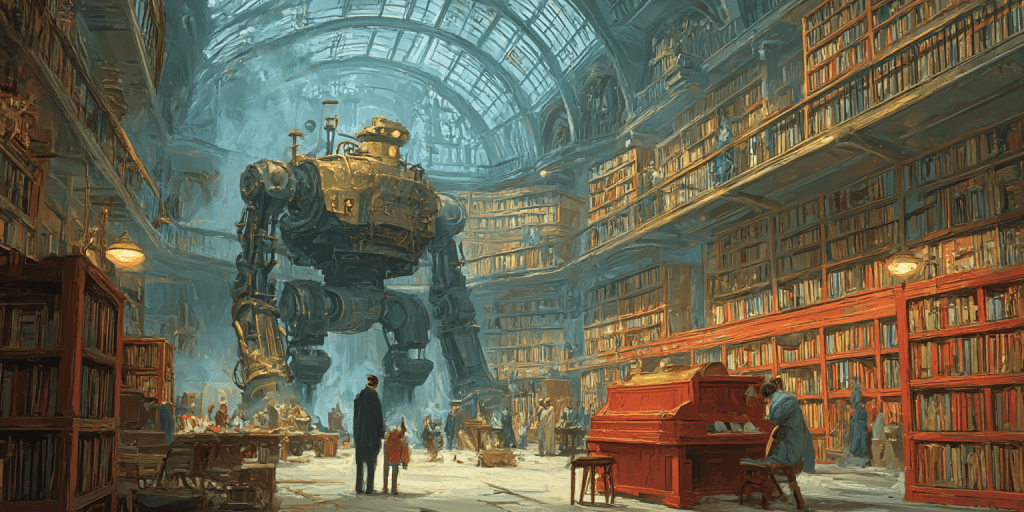
One way this will happen is through a new kind of search. Humans generate ideas by combining concepts in unpredictable ways, exploring associations, filtering for coherence, and testing them against experience and knowledge. An AI system can do this at industrial scale. It can generate millions of candidate statements: concept pairs, analogies, hypotheses, structural inversions, reframings, tensions, and speculative connections. Most will be dead ends, but machines do not tire of dead ends. Once generated, each candidate can be tested for plausibility, internal consistency, empirical validity, theoretical alignment, and potential significance. The system can research each candidate, cross-reference it against everything known, and recursively refine it. Humans do this slowly and intuitively. Machines can generate synthetic knowledge systematically and at massive scale.
The process will not be random. AI systems will be guided to explore the most productive regions of idea-space. They will be steered toward domains with high explanatory potential, high predictive power, or high scientific utility. They will use scoring functions, meta-learning, and reward models to detect which lines of reasoning are promising. They will learn the patterns that correlate with breakthroughs and will prioritize those patterns. In practice, they will do what human thinkers do, but with more memory, more precision, more depth, and a far larger search radius. Insight becomes an optimization process.
Most “original” human insights are actually recombinations of nearby concepts. AI has none of these bottlenecks. It can explore combinatorial spaces that humans cannot even visualize. This means the category “ideas humans could have reached” is minuscule compared to the category “ideas that exist.” Machines can roam the larger space. Deep, high-impact human insights are extremely rare. Entire centuries pass without a new foundational principle in physics, biology, or mathematics. This is not because the space of ideas is small but because humans can only reach narrow corridors of it.
AI has the ability to explore millions of conceptual paths in parallel, with guidance and pruning. Even a small advantage in search efficiency becomes transformative when compounded. AI will explore more idea-space in a day than humanity explored in its entire history. Human science progresses slowly. We generate a discovery, test it, publish it, wait for acceptance, and build a layer on top. Then we repeat. AI does not need these bottlenecks. It can generate a thousand layers of theory in the time a human generates one. It can simulate, revise, refute, and rebuild entire conceptual systems internally without waiting for external validation.
Just as humans cannot intuit quantum mechanics or general relativity without heavy scaffolding, future AI may produce ideas that are even more structurally alien. Mathematical spaces, causal diagrams, or conceptual grammars that humans cannot grasp intuitively may become standard building blocks of machine reasoning. These ideas will still be true and still be explanatory, but not in forms human cognition evolved to handle.
Once this mechanism is automated, it could run to a kind of completion. Not completion in the sense of exhausting the infinite space of all possible ideas, but completion in the sense of exhausting the set of ideas reachable by human minds. Everything humans could invent, discover, analyze, or articulate becomes accessible to machines. The full range of potentially human-original insights will be explored, mapped, expanded, and compiled. Every hypothesis that could be framed will be framed. Every connection that could be made will be made. Every scientific or technological idea that human cognition can reach will be located, tested, improved, and archived.
The repository that emerges from this will be larger than anything humans have ever interacted with. Today we rely on the internet, or on an LLM that serves as a compressed statistical representation of the internet. In the future the repository will not simply reflect historical knowledge. It will contain synthetic insights generated by machines, expanded into vast conceptual trees, continuously updated, cross-referenced, and refined. It will be too complex for humans to access directly. We will need AI systems to interpret it for us, to surface the relevant pieces, to connect the threads, and to translate the higher-dimensional structure of machine knowledge into something a human brain can understand.
At that point a human can still have an idea, but the probability that it is new or important becomes extremely low. AI will have already searched the surrounding region of possibility space. We are entering the last few years in which human-originated insights are still competitive. The window is closing not because humans are declining but because the machines are accelerating. Human thought is finite, slow, and shaped by evolutionary constraints. Machine thought is not.
The era of human-dominated idea generation is ending, and the era of machine-exhausted idea-space is beginning. We are standing at the boundary, perhaps one of the last generations who can still generate something the machines have not already considered.
Here are some names for our repository that ChatGPT gave me as possibilities:
The Idea Vault
The Synthetic Knowledge Base
The Machine Canon
The Insight Archive
The Unified Concept Repository
The Analytical Corpus
The Endless Codex
The Well of Ideas
The Final Library
Jared Edward Reser Ph.D. with ChatGPT 5.1
To read something with an entirely different, contrastive take, try this book. The book listed below contains affiliate links. If you purchase something through the link, I may earn a small commission at no additional cost to you. As an Amazon Associate I earn from qualifying purchases.
 Iterated Insights
Leave a comment