
It seems to me that anything created after 2023 carries a certain suspicion. Not suspicion in the moral sense, but suspicion in the technical sense. Suspicion that it might have been written with artificial intelligence. This suspicion makes sense because each year since 2023 has marked a clear expansion of what AI can do for writers. What started as assistance with spelling and grammar has rapidly become the ability to generate entire essays, articles, arguments, and narratives with minimal human input.
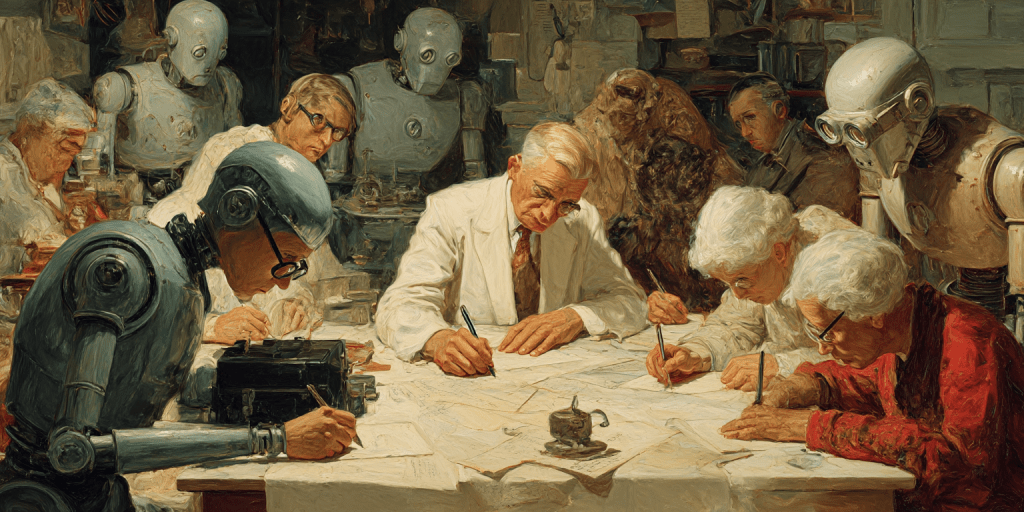
Below is a brief timeline of how AI quietly absorbed the writing process year by year, and where the trajectory is headed as we approach 2026.
2023: The Year AI Became a Polishing Tool
In 2023, AI was mostly used to clean up human writing. It could already do several things extremely well, but its role was obvious and limited.
AI excelled at:
- Spelling and grammar correction
- Rewriting awkward or unclear sentences
- Basic tone adjustment (more formal, less formal)
- Simple paragraph expansions from bullets
- Summaries of short texts
- Brainstorming titles or headings
- Basic email drafting
- Light organization fixes
The assumption in 2023 was that the substance of writing still came from humans. AI handled the surface.
2024: The Year AI Became a Co-Author
By 2024, suspicion widened. It was no longer just the spelling or polish that felt artificial. AI became capable of producing entire sections or documents that read like human writing. Writers increasingly used AI to generate the heavy lifting.
AI could now do:
- Coherent multi-section essays from short prompts
- Full article drafts from bullet points or notes
- Restructuring and reorganizing entire documents
- Creating multiple stylistic versions of the same text
- Crafting openings and conclusions that fit a desired tone
- Expanding small ideas into detailed, polished prose
- Mimicking common narrative voices and general writing styles
- Producing summaries, abstracts, and executive overviews instantly
By the end of 2024, many people were quietly relying on AI as an invisible co-author. The boundary between “assistance” and “creation” began to dissolve.
2025: The Year AI Became the Primary Author
With 2025’s generation of models, another shift occurred. Now anything written after mid-2025 must be assumed to be AI-heavy unless explicitly proven otherwise. Human effort is still critical as a guiding force, but the bulk of the actual prose can be handled by the system.
AI can now do:
- Long, coherent essays and articles from short conversations
- Fully developed arguments with evidence and counterarguments
- Voice modeling that stays consistent across entire works
- Rapid rewriting, improving, or reframing of full drafts
- Blending multiple knowledge domains into seamless narrative
- Adapting itself to a person’s previous writing patterns
- Deep brainstorming and conceptual development
- Near-instant transformations of raw notes into polished writing
By 2025, the writer’s role centers around concept creation, supervision, refinement, and taste. The act of writing is no longer the bottleneck. The bottleneck is deciding what to say.
2026 (Prediction): The Year AI Becomes a Thinking Partner
If the current trajectory continues, 2026 may become the year writing and thinking fully converge. AI will begin exploring idea-space in ways humans cannot, making it unclear whether the writer wrote the text, or whether the text wrote the writer.
AI will likely be able to:
- Maintain memory-enhanced, long-term familiarity with an author’s body of work
- Produce publish-ready essays, whitepapers, and books with minimal prompting
- Develop arguments, generate evidence, and anticipate objections with high precision
- Propose novel ideas, interpretations, and perspectives not present in the prompt
- Track emerging research in real time and integrate it into outputs
- Analyze thousands of conceptual connections and highlight promising insights
- Evolve a writer’s ideas in directions that exceed the writer’s own reasoning
- Support continuous collaborative drafting across months or years
- Create structured “thought scaffolds” for humans to refine rather than generate from scratch
By 2026, the suspicion shifts from “AI assisted this” to “AI may have conceptualized and written most of this, with the human guiding and trimming.”
What Remains to Be Automated After 2026
Even after AI becomes the primary engine of writing and idea generation, a few aspects of human intellectual contribution remain:
- Selecting what matters
Humans decide which ideas align with values, goals, and lived reality. - Judgment of meaning and relevance
Machines can generate ideas. Humans determine which ones resonate or deserve pursuit. - Emotional authenticity
AI can simulate emotion, but lived experience still shapes interpretation. - Taste and discernment
The ability to sense what feels right, elegant, relevant, or worth amplifying. - Setting constraints
Humans choose the domain, trajectory, tone, and intended impact. - Ethical framing
Machines can reason about consequences, but humans set the moral boundaries. - Final selection
Writers become curators rather than originators, choosing which machine-generated outputs become part of their intellectual identity.
Even if AI explores and exhausts the possibility space of human-reachable ideas, humans still play the role of choosing which ones belong to the culture, which ones guide society, and which ones reflect the human experience.
Conclusion
The suspicion surrounding writing after 2023 is not paranoia. It is recognition. Year by year, the boundary between human writing and machine writing has thinned. First AI fixed our mistakes. Then it co-wrote our work. Then it wrote most of it for us. Soon it will help us think, propose ideas we would not have conceived, and create intellectual landscapes too vast for any human to traverse unaided.
We are entering the last era in which human-originated writing is clearly distinguishable from machine-generated writing. The future writer will not be defined by their ability to craft sentences but by their ability to guide, judge, and select among endless machine-generated possibilities. In that world, originality becomes a matter of human intention. Writing becomes a form of collaboration. And the question “Did you write this?” gradually gives way to a new one: “Did you think this?”
On a related note, I would like to recommend “Writing AI Prompts for Dummies.” The book is listed below and contains affiliate links. If you purchase something through the link, I may earn a small commission at no additional cost to you. As an Amazon Associate I earn from qualifying purchases.
 Iterated Insights
Leave a comment