
The conversation around technological displacement has centered on programmers for several years. Coders were the first major knowledge workers to feel a direct, hands-on transformation in their daily workflow. Just a few years ago, this began quietly with GitHub Copilot, which acted like an autocomplete engine that could finish a line of code or suggest a function signature. Then models improved to the point where they could generate small utilities and trivial scripts. The community treated these as interesting conveniences. They felt like clever assistants rather than competitors.
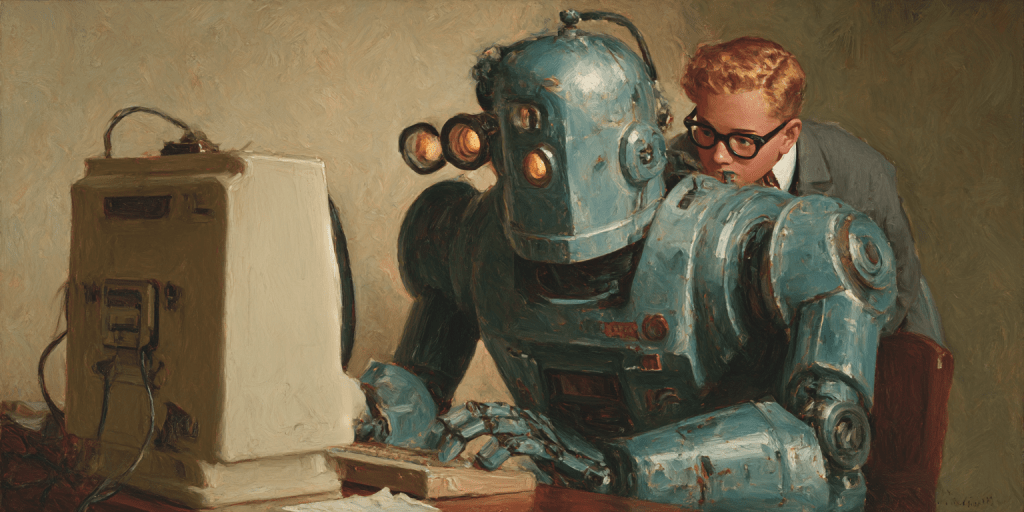
By 2024 and 2025, this started to change. The systems were no longer limited to one-off snippets. They could write entire programs. They could reason through multi-step tasks. They could interpret vague requirements and translate them into functional modules. They still relied heavily on human oversight, but the amount of debugging required started to drop. What once demanded careful manual review now demanded only light supervision. More advanced models began performing well on software engineering and agentic coding benchmarks, not just simple programming benchmarks. They showed early signs of agentic capability: the ability to plan, iterate, revise, and correct their own attempts.
No one claims that software engineers have been replaced, but the conversation has shifted. Many people now think it could happen in 2026. And in the meantime, coders themselves are changing. The new normal is to lean heavily on AI tools. Developers report that they check less, debug less, and write less by hand. The bottleneck is no longer typing or syntax, but deciding what they want the system to build. The act of programming has changed from writing instructions to sculpting and steering a machine that already knows how to write the instructions for you.
A parallel shift is happening for writers, thinkers, and scientists.
A few years ago, AI could correct spelling or grammar. It could suggest synonyms. It could provide structure. Now it offers superhuman spelling, superhuman grammar, and superhuman organization. It has superhuman knowledge and expertise. It retrieves, cross references, summarizes and synthesizes information across domains with a speed that no human can match. The one missing component is continuous learning, where a system can accomplish long-horizon tasks never forgetting what it set out to do, but that is clearly on the horizon. Memory is not a conceptual challenge. It is an engineering detail that will be solved in months or years, not decades. The intellect is already here.
This creates a new landscape for authors, researchers, and analysts. An author does not need to write an entire essay, article, report, or analysis by hand. They can have a short conversation with an AI system and then let the AI produce the document. They can review it, refine it, adjust it, and guide it, but the mechanical part of writing is becoming unnecessary. In coding, it is already considered normal and acceptable to let AI write large portions of a project. This is becoming true for writing as well. To insist on writing everything from scratch is beginning to feel like refusing to use a dictionary or thesaurus. It is an artificial constraint that limits output and wastes cognitive energy.
The pattern is clear. The bottleneck is no longer the act of writing but the act of thinking. The human does not need to type every sentence. The human needs to provide the insight, the framing, the direction, and the taste. AI can expand, organize, deepen, and operationalize those insights at a speed that was unimaginable even a few years ago. The result is that every writer now has access to the equivalent of a full-time research assistant, an editor, a subject matter consultant, and a stylist who can transform rough ideas into polished prose. This is the same separation that occurs when a director does not operate the camera or when a scientist does not run every statistical procedure manually. It is not a degradation of authorship. It is a transition to a higher level of abstraction.
Programmers are already describing the change in their field. Some claim that every software engineer should be shipping at ten times their previous velocity today, with the potential for one hundred times in the next year. Writers are at the same inflection point. If the tools exist, it is reasonable to use them. The purpose of writing is to express ideas, and the tools that expand human expression should not be seen as shortcuts. They should be seen as the new environment of thought.
Another shift I am beginning to notice is that AI can now muse. It has absorbed millions of examples of speculation, reflection, and philosophical wandering, and it can synthesize them into something more fluent, more playful, and often more creative than what any individual person might produce. The systems are not only competent at structured exposition. They can ramble with intention. They can spin metaphors, produce intellectual side paths, and explore conceptual spaces with an ease that feels almost unfair. In fact, AI may already be the best “muser” in existence. The place where the human still adds irreplaceable value is not in the musing itself but in the seed. The human contribution becomes the original twist, the new insight, the novel hypothesis that was not previously in the model’s manifold. Once that seed exists, the system can bloom it into an entire conceptual ecosystem.
We are at an unusual moment in history. AI agents have not yet reached the point where they can autonomously generate anything a human can, but they are close. In the meantime, authors and coders are in a privileged position. They are elevated by the tools. Their abilities are expanded. Their workflows are transformed. The systems are not replacing them, but they are amplifying them. The right way to think about authorship today is not as a solitary act of typing but as a collaborative process between human insight and machine synthesis.
Writers have historically feared the blank page. Coders did not fear a blank directory because they always had boilerplates, templates, skeletons, and prior projects to clone. AI turns every blank page into a draft. And once there is a draft, writers can revise instead of conjure. Humans are far better editors than generators. Creativity often flows more freely when reacting to something rather than producing it in isolation.
It may be time for writing circles, academic circles, and professional circles to acknowledge this openly. People are already writing for an AI audience. People are already exchanging ideas through systems that are capable of interpreting, reformulating, and extending them. The act of writing is becoming a dialogue rather than a monologue. And when a dialogue can instantly become a finished product, the distinction between thinking and writing begins to blur.
Today, writers feel hesitant to admit heavy AI involvement. Coders do not. That difference is cultural, not logical. Once writing communities accept the new tools, the stigma will fade. The early adopters will define the new norms. Eventually, the question will not be “Did you use AI?” It will be “Did you use it well?”
Writers should not pretend that the world has not changed. If programmers have accepted AI as a natural extension of their ability, writers should consider doing the same. For now, the mind remains the origin of the idea, but the mechanism that turns an idea into a polished artifact has evolved. The sooner we embrace that, the more productive and expressive this period of transition will be.
Jared Edward Reser Ph.D. with ChatGPT 5.1
On a related note, I really enjoyed The Age of A.I. by Schmidt and Huttenlocher. The book is listed below and contains affiliate links. If you purchase something through the link, I may earn a small commission at no additional cost to you. As an Amazon Associate I earn from qualifying purchases.
 Iterated Insights
Leave a comment